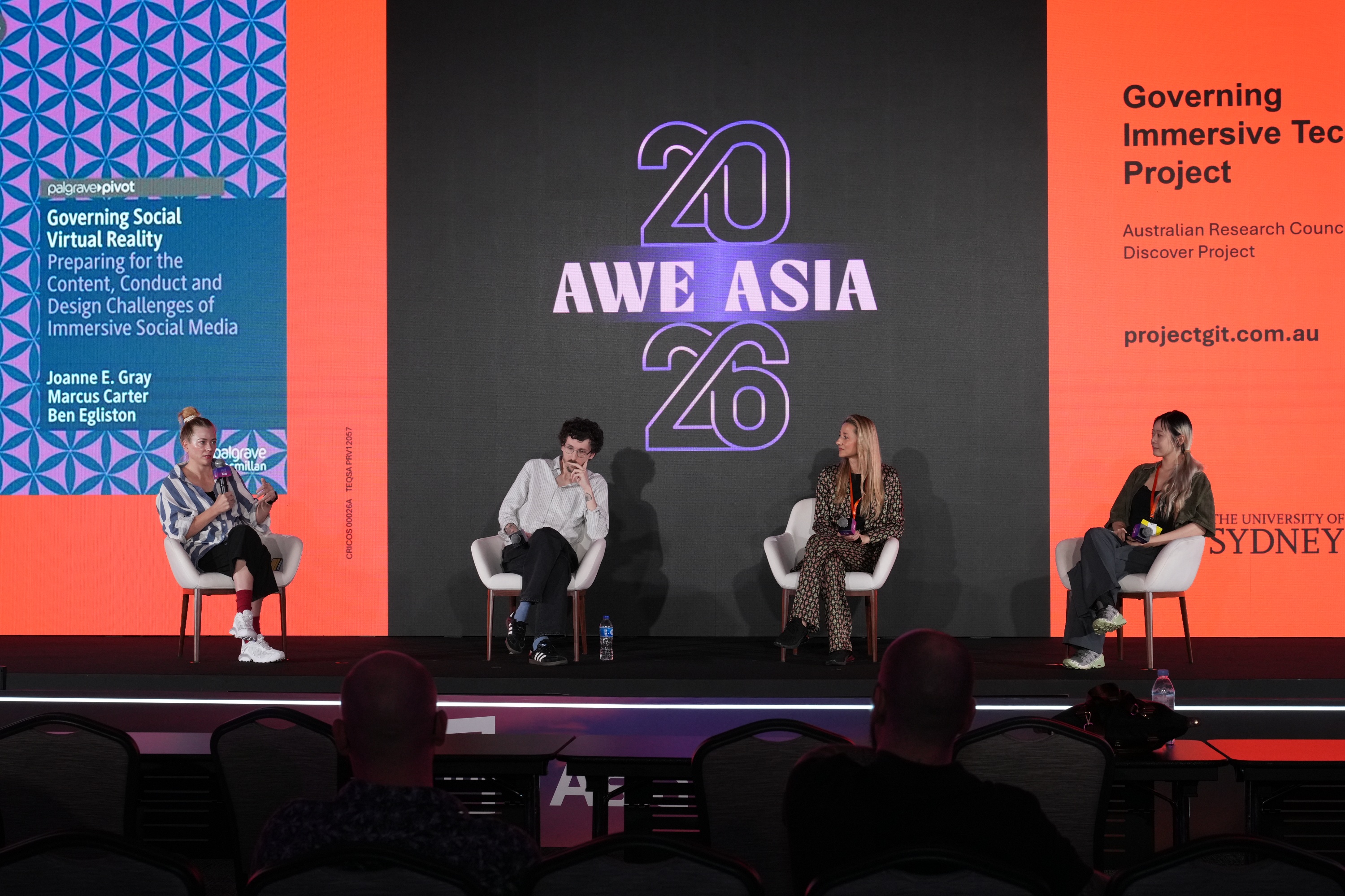
From February 2–4 2026, the Governing Immersive Tech project team joined leading XR companies, investors, and other international stakeholders at AWE Asia 2026 in Singapore to speak about proactive XR governance.
In our panel session, we explored the critical question: how do we navigate real, anticipated, and existing XR challenges—and how can we do it well?
Three Key Takeaways
-
XR governance must happen now
Governing an emerging technology like XR can feel difficult. But, in a future where XR is entrenched in society, effecting meaningful change through governance will prove significantly more challenging.
Postponing conversations about ethical and responsible XR development can be costly. XR is already on the policy table in Australia and globally. In this environment, XR industry stakeholders that take questions of governance seriously will be better positioned to build sustainable technology that serves the public interest.
-
History can pave a path to a more responsible XR future
We do not have to govern in the dark. The Internet, social media, and mobile technology offer an abundance of cautionary lessons that proactive XR governance can draw from. The threats of invasive data capture, underestimated sociocultural impact, and persistent failures to center accessibility and inclusion from the outset are well-documented. Moreover, existing laws and regulation provide frameworks for many current and anticipated XR harms. XR governance must build upon technological histories to avoid replicating the harms of the past.
-
Collaboration with government, research institutions, and users is key to good XR governance
No single actor can govern XR well alone. Meaningful, durable, and effective governance frameworks require collaboration between industry, governments, research institutions, and—most critically—users. Yet, for such collaboration to stick, there must also be a reframing of what governance is: not the barrier that hampers technological advancement, but the blueprint that enables XR development that is responsible, sustainable, and in the public interest.
Full Session Video
Watch a video of our full panel session here.
BACK TO NEWS